
Evaluation of Antimicrobial and Antioxidant Properties of Active Starch-Based Food Packaging Films Enriched with Citric Acid
-
James Gana Josiah
Department of Biotechnology, Mewar International University, KM 21, Abuja-Keffi Road, Nasarawa, Nigeria
Bright Ayemwenre Omoike

Department of Research Outreach, Rubber Research Institute of Nigeria, Iyanomo, Benin, Nigeria
Emmanuel Onyekachukwu ChikwenduDepartment of Biotechnology, Mewar International University, KM 21, Abuja-Keffi Road, Nasarawa, Nigeria
| Received 15 Apr, 2026 |
Accepted 10 Sep, 2026 |
Published 20 Sep, 2026 |
Background and Objective: Growing environmental concerns regarding synthetic packaging materials have accelerated interest in biodegradable and functional food packaging alternatives. This study aimed to formulate and characterize starch-based biodegradable food packaging films enriched with different concentrations of citric acid to enhance their antioxidant and antimicrobial properties. Materials and Methods: Starch-based films were prepared using starch, polyvinyl alcohol (PVA), kaolin, citric acid, and glycerol as a plasticizer. Kaolin clay was incorporated as a reinforcing agent, while citric acid was used as a functional additive at concentrations of 0, 2.5, 5, and 7.5%. Antioxidant activity was evaluated using the 2,2 -azino-bis(3-ethylbenzothiazoline-6-sulfonic acid) (ABTS) radical scavenging assay, whereas antimicrobial activity was determined by the agar well diffusion method against Escherichia coli and Staphylococcus aureus. Statistical analysis was performed using BMDP 2R software (version 7.0) for stepwise multiple regression, with results expressed as mean±replicate measurements (n = 3) and significance set at p<0.05. Results: The findings demonstrated a positive correlation between citric acid concentration and the bioactivity of the films. The film containing 7.5% citric acid exhibited the highest ABTS radical scavenging activity, approaching the antioxidant potential of the vitamin C control. Similarly, the same formulation showed the largest inhibition zones against both test microorganisms, indicating enhanced antimicrobial efficacy. These results suggest that citric acid contributes not only as a natural cross-linking agent b ut also as a bioactive enhancer in starch-based films. Conclusion: Citric acid-enriched starch-based films exhibited promising antioxidant and antimicrobial properties, highlighting their potential as environmentally friendly food packaging materials. The developed films may contribute to improved food safety and shelf-life extension, offering a sustainable alternative to conventional synthetic packaging in the food industry.
| Copyright © 2026 Josiah et al. This is an open-access article distributed under the Creative Commons Attribution License, which permits unrestricted use, distribution, and reproduction in any medium, provided the original work is properly cited. |
INTRODUCTION
The world is currently facing a significant environmental crisis due to the widespread use of plastic materials, arising especially from industries such as food packaging1,2. Conventional plastics derived from petrochemical resources have been widely used due to their low cost, ease of processing, and favourable mechanical and barrier properties3-5. However, these plastics contribute to environmental degradation as they accumulate in landfills and take centuries to degrade, while incineration practices release harmful gases into the atmosphere6,7. With the emergence of material science, modern biotechnology, and new biomaterials, there is a critical need for sustainable alternatives8,9. The development of biodegradable films from renewable resources like cellulose, starch, and gelatin is one of such currently gaining increased traction5. These materials in view of their eco-friendliness have become a new generation of hot research and development projects as well as a cutting-edge strategy for achieving global economic and sustainable development goals10.
Among the available alternatives, starch has emerged as one of the most promising materials due to its good thermoplastic behavior, abundant availability, and low cost11,12. However, major limitations of starch are poor mechanical and barrier properties as well as lack of inherent antimicrobial and antioxidant properties necessary for food preservation, thus restricting its industrial applications. Therefore, researchers are now focused on ways of enhancing the material and bioactive properties of starch-based films for its suitability in food packaging. To address these natural shortcomings of starch films, various strategy are being employed.
One approach is the blending of starch with biopolymers such as polyvinyl alcohol (PVA) to enhance its mechanical and barrier properties2,13. PVA is a semicrystalline and water-soluble polymer recognized for its excellent film-forming properties, biodegradability, non-toxicity and good mechanical properties11,14. PVA exhibits good oxygen barrier properties and can be tailored for various packaging applications. Its compatibility and ability to form strong bond with starch polymers make it a choice component in starch-based films for enhancing structural integrity, flexibility, and overall performance15.
Another strategy to improve the properties of starch-based films is by reinforcing with fillers like kaolin16. Kaolin clay is a naturally occurring layered silicate mineral with established promising reinforcement ability in bio-based polymeric films17. It is non-toxic and environmentally friendly, and has been recognized for its useful applications in the industry18. Its inclusion in starch-based films enhances it mechanical, thermal, and barrier properties16.
Another promising approach to improve packaging systems is the concept of active packaging. It is a concept which involves incorporating active substances into biopolymer matrices to improve their antimicrobial and/or antioxidant properties, and hence promoting the shelf life of the packaged product19,20. These substances are encapsulated within the polymer matrices and released intermittently into the internal environment of the packaging film to inhibit the growth of spoilage microorganisms on food surfaces21. Among the various bioactive compounds available, citric acid has gained significant attention due to its multifunctional properties as an antimicrobial, antioxidant, and reinforcing/crosslinking agent20,22,23. Citric acid is a weak organic acid naturally found in citrus fruits and is widely recognized for its Generally Recognized as Safe (GRAS) status1.
Previous studies have investigated the incorporation of citric acid into a wide spectrum of starch-based polymer matrices1,5,20. For example, Menzel20 employed the use citric acid as a crosslinking agent to successfully improve the properties of starch-based films enriched with sunflower. Similarly, Reddy and Yang24 demonstrated the efficacy of citric acid in cross-linking starch films and improving its tensile strength, thermal properties and reducing its water solubility. In another study, Wu et al.5 developed a ternary blend system of starch, PVA, and citric acid and applied it to preserve the freshness of fig fruits
by inhibiting microbial growth. The study ascribed the freshness-preserving efficacy of the blend to the strong antimicrobial action of citric acid. Despite these promising findings, there is a dearth of data and information on ternary starch-PVA-kaolin composite system incorporated with citric acid. This study addressed this knowledge gap by exploring the aforementioned starch-based films loaded with citric acid for prospective application as active food packaging.
The main objective of this study is to evaluate the antimicrobial and antioxidant properties of citric acid-enriched starch-PVA-kaolin packaging films and their contributions to the advancement of eco-friendly and functional food packaging systems.
MATERIALS AND METHODS
Study area and sites: This research took place in Masaka, Nasarawa State, Nigeria. It is positioned at a latitude of 10.80°N and a Longitude of 14.99°E. The city’s elevation is 448 m above sea level, with a population of over 116,600, based on 2020 population statistics.
Materials: The 500 g of starch, 500 g of polyvinyl alcohol (PVA), glycerol, and anhydrous citric acid of analytical grade were purchased from a chemical supply store in Kaduna State. Kaolin clay was sourced from a factory in Katsina State. Microorganisms (Escherichia coli and Staphylococcus aureus) used in this study were obtained from the Department of Microbiology at Ahmadu Bello University. All other chemicals and reagents of analytical grade were obtained from the Chemistry and Biology Laboratory, Mewar International University, Nigeria. This study spanned from November, 2024 to July, 2025.
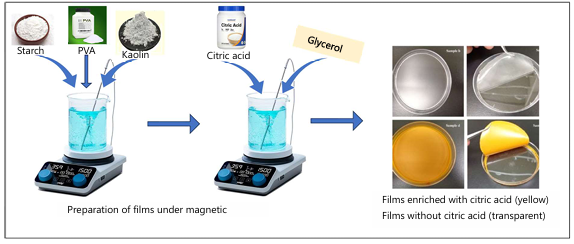
Preparation of starch/polyvinyl alcohol/kaolin clay film: The starch-polyvinyl alcohol (PVA)-kaolin composite film was prepared at the Biology Laboratory of Mewar International University, Nigeria, using the solvent casting method, as described by Omoike et al.16 with slight modifications. The film was prepared by dissolving 3 g of polyvinyl alcohol (PVA) in 50 mL of distilled water using a magnetic stirrer at 90°C for 30 min, until a clear, viscous, lump-free solution was formed. In a separate container, 4.5 parts per hundred (pph) of kaolin clay (based on total dry weight) were dispersed in 20 mL of distilled water and stirred for 1 hr using a magnetic stirrer to ensure uniform dispersion of the clay particles. Subsequently, 2.0 g of starch was added to the kaolin suspension and stirred for an additional 30 min to obtain a homogeneous mixture. The resulting kaolin-starch mixture was then slowly added to the PVA solution and stirred until a uniform blend was obtained. During this process, 1 mL of glycerol was added as a plasticizer. Finally, the starch-PVA-kaolin filmogenic solution was gently poured into a 5×5 cm glass mold to allow for even distribution on the glass surface. The glass mold with the contents was oven-dried for 16 hrs. After drying, it was allowed to cool and cure at room temperature, following which the film was peeled off the mold. The film was then stored in a desiccator for analysis.
Preparation of starch-based composite film incorporated with citric acid: The starch-polyvinyl alcohol (PVA)-kaolin composite film enriched with citric acid was prepared as described by Omoike et al.25 with some modifications as follows. First, the filmogenic solution of starch, polyvinyl alcohol (PVA), and kaolin was prepared as described in the preceding section. Thereafter, citric acid of varying amounts corresponding to 0, 2.5, 5.0, and 7.5% citric acid was dissolved in their respective amounts in 10 mL of distilled water. The resulting citric acid solutions were added to the filmogenic solutions containing starch, polyvinyl alcohol (PVA), and kaolin. The mixture was stirred thoroughly to ensure proper incorporation. Upon cooling, the final film solution was cast onto glass molds measuring 5×5 cm, ensuring the base was completely covered. The molds were placed in a drying oven at 70°C for 16 hrs. After drying, the films were carefully peeled off and kept in a desiccator for analysis. The composition used in the preparation of the films is presented in Table 1. Figure 1 shows the schematic flowchart for the preparation of the starch-based films enriched with citric acid.
|
| Table 1: | Formulations used for the preparation of films | |||
| Films | Starch (%) | PVA (%) | Kaolin (pph) | Citric acid (%) |
| Starch-PVA-kaolin-CA (0%) (control) | 60 | 40 | 4.5 | 0 |
| Starch-PVA-kaolin-CA (2.5%) | 60 | 40 | 4.5 | 2.5 |
| Starch-PVA-kaolin-CA (5.0%) | 60 | 40 | 4.5 | 5.0 |
| Starch-PVA-kaolin-CA (7.5%) | 60 | 40 | 4.5 | 7.5 |
| Polyvinyl alcohol (PVA) | ||||
Antimicrobial activity test
Test microorganisms preparation: The antimicrobial activity of the starch-based films was conducted at the biology laboratory of Mewar International University against selected food spoilage and pathogenic bacteria, which included: Escherichia coli (Gram-negative) and Staphylococcus aureus (Gram-positive). The bacterial strains were obtained from the Department of Microbiology, Ahmadu Bello University, Zaria, and maintained on nutrient agar slants at 4°C before use.
Culture preparation: The cell culture was prepared using methods as described by Wu et al.5. A loopful of each bacterial strain was inoculated into 10 mL of sterile nutrient broth and incubated at 37°C for 18-24 hrs. The bacterial suspension was adjusted to match 0.5 McFarland standard (~1.5×10⁸ CFU/mL) to ensure uniformity in microbial load.
Preparation of film samples: Starch-based films, both with and without citric acid (control), were cut into uniform discs of 1 cm by 1 cm using a sterile cork borer as described by Wu et al.5. The discs were sterilized under UV light for 15 min before being used for antimicrobial testing.
Agar well diffusion assay: The antimicrobial activity of the film samples was evaluated using the agar well diffusion method, as described by Wu et al.5 with slight modifications. Mueller-Hinton agar was prepared and poured into sterile 5×5 cm glass molds (approximately 25 mL per mold) and allowed to solidify. Each mold was then inoculated with 0.1 mL of the prepared bacterial suspension and evenly spread using a sterile glass spreader. Wells of 6 mm diameter were bored into the agar using a sterile cork borer, and each well was carefully filled with the test samples, which included either film discs or film extract solutions. For the film extract, a piece of the starch-based film was soaked in 1 mL of sterile distilled water for 2 hrs before use. The molds were incubated at 37°C for 24 hrs. After incubation, the antimicrobial effect was assessed by measuring the zones of inhibition (clear areas around the wells) in millimeters using a transparent ruler. All tests were performed in triplicate to ensure accuracy and reproducibility. The mean values of the zones of inhibition were calculated and recorded.
Antioxidant activity test
Preparation of ABTS radical solution: The determination of the antioxidant activity of the starch-based films was conducted in the Biochemistry laboratory of Nasarawa State University, Keffi. The antioxidant activity of the film samples was determined using the 2,2 -azino-bis(3-ethylbenzothiazoline-6-sulfonic acid) (ABTS) radical scavenging assay based on the methodology of Okhale et al.26. The ABTS working solution was prepared by mixing 7 mM ABTS stock solution with 2.45 mM Potassium Persulfate (K2S2O8) in equal volumes. The mixture was allowed to react in the dark at room temperature for 12-16 hours to form the ABTS radical cation. Before use, the ABTS solution was diluted with methanol to obtain an absorbance of 0.70±0.02 at 734 nm.
Preparation of film extracts: Approximately 0.5 g of each starch-based film (both with and without citric acid) was soaked in 10 mL of methanol for 24 hrs at room temperature in the dark with intermittent shaking. The extracts were filtered using Whatman No. 1 filter paper and used for the assay.
ABTS assay procedure: This study adopted the methodology outlined by Okhale et al.26 with specific modifications. To perform the assay, 1 mL of the film extract was mixed with 2 mL of the diluted ABTS working solution in a test tube. The mixture was vortexed and incubated in the dark at room temperature for 6 min. After incubation, the absorbance was read at 734 nm using a UV-Visible spectrophotometer, with methanol as the blank. A control was prepared by replacing the extract with methanol under the same conditions. The percentage inhibition of ABTS radical scavenging activity was calculated using the formula stated in Eq. 1:
 |
(1) |
Where:
| Ao | = | Absorbance of the control (ABTS+methanol) | |
| A1 | = | Absorbance of the sample (ABTS+film extract) |
All assays were carried out in triplicate to ensure reproducibility. The mean percentage inhibition values were calculated and recorded to represent the antioxidant potential of each film sample.
Tools and equipment manufacturers: The instruments used in this study, such as the magnetic stirrer, digital caliper, petri dishes, oven, analytical balance, desiccator, and other equipment, were obtained from well-known manufacturers, including Hanna Instruments (Woonsocket, Rhode Island, USA), Thermo Fisher Scientific (Waltham, Massachusetts, USA), and Mettler Toledo (Columbus, Ohio, USA), among others.
Statistical analysis: The statistical analysis was carried out using the BMDP 2R software (version 7.0) for stepwise multiple regressions. Data were presented as the mean of three replicate measurements. The findings of the study were considered statistically significant at p<0.05.
RESULTS AND DISCUSSION
Formulation of starch-based films: All Starch-based film formulations yielded uniform, flexible sheets, with observable differences in texture and appearance based on the concentration of citric acid. Films without citric acid appeared slightly more brittle and less transparent, while increasing citric acid concentrations produced smoother, glossier films with improved flexibility and a slight yellowish tint.
Antimicrobial activity: The result of the antimicrobial activity of the films is illustrated in Table 2 in terms of the mean zones of inhibition (mm). The antimicrobial properties of the films were assessed against two common foodborne pathogens, Escherichia coli (Gram-negative) and Staphylococcus aureus (Gram-positive), using the agar well diffusion method. The baseline film (0% citric acid) exhibited minimal antimicrobial activity, with zones of inhibition measuring approximately 6 mm, which is considered weak. However, films containing citric acid showed improved antimicrobial effectiveness. As the citric acid concentration increased from 2.5 to 7.5%, there was a corresponding increase in the diameter of the inhibition zones for both bacteria. The 7.5% citric acid film produced inhibition zones measuring between 13.08 mm (for E. coli) and 14.92 mm (S. aureus), indicating significantly enhanced antibacterial activity, with slightly greater activity against Staphylococcus aureus, suggesting a stronger efficacy against Gram-positive bacteria27. These results are consistent with findings from previous studies, such as Cano et al.23 who observed that incorporation of natural antimicrobials like citric acid enhanced the antimicrobial property of starch-PVA films.
| Table 2: | Zone of inhibition (mm) of starch-based films with varying citric acid concentrations against E. coli and S. aureus | |||
| Zones of inhibition (mm) | ||
| Films (citric acid concentration) | Escherichia coli | Staphylococcus aureus |
| Starch-PVA-kaolin-CA (0%) (control) | 6.00±0.00 | 6.00±0.00 |
| Starch-PVA-kaolin-CA (2.5%) | 8.13±0.23 | 9.27±0.35 |
| Starch-PVA-kaolin-CA (5.0%) | 10.62±0.51 | 12.14±0.41 |
| Starch-PVA-kaolin-CA (7.5%) | 13.08±0.46 | 14.92±0.28 |
| 6.00 mm represents the diameter of the well with no inhibition observed, polyvinyl alcohol (PVA) | ||
| Table 3: | ABTS radical scavenging activity (%) of starch-based films at varying concentrations of citric acid | |||
| Sample | Conc. (mg/mL) | ABTS radical scavenging activity (%) |
| Vitamin C (Control) | 0.2 | 50.29±0.34 |
| 0.4 | 51.57±1.08 | |
| 0.6 | 53.45±1.19 | |
| 0.8 | 54.34±0.51 | |
| 1.0 | 55.26±0.32 | |
| 0% Citric acid | 0.2 | 41.03±0.64 |
| 0.4 | 41.92±0.26 | |
| 0.6 | 45.76±0.15 | |
| 0.8 | 46.94±0.49 | |
| 1.0 | 47.47±0.25 | |
| 2.5% Citric acid | 0.2 | 40.97±0.23 |
| 0.4 | 43.30±0.94 | |
| 0.6 | 44.72±1.26 | |
| 0.8 | 45.35±0.26 | |
| 1.0 | 46.32±0.69 | |
| 5.0% Citric acid | 0.2 | 42.75±0.65 |
| 0.4 | 44.34±1.05 | |
| 0.6 | 47.63±0.31 | |
| 0.8 | 48.93±0.54 | |
| 1.0 | 48.92±0.04 | |
| 7.5% Citric acid | 0.2 | 43.02±0.36 |
| 0.4 | 45.16±0.65 | |
| 0.6 | 48.00±1.04 | |
| 0.8 | 49.54±0.52 | |
| 1.0 | 51.00±0.49 |
This enhancement in antimicrobial activity can be attributed to the acidic nature of citric acid, which helps lower the pH of the surrounding environment, creating unfavorable conditions for bacterial growth5,28,29. Moreso, citric acid is known to disrupt bacterial cell membranes, by breaking down the synthesis system between protein and cell membrane, thereby increasing membrane permeability and leading to microbial cell death5. Citric acid may also chelate essential metal ions required for bacterial enzymatic activity, further inhibiting their function30. Interestingly, the films enriched with citric acid were slightly more effective against Staphylococcus aureus than Escherichia coli, which aligns with existing literature suggesting that Gram-positive bacteria are generally more susceptible to organic acids due to the absence of an outer membrane a feature that typically protects Gram-negative bacteria from acidic compounds. This is consistent with the findings of Wu et al.5, Omoike et al.25 and Ahmad et al.27.
Antioxidant activity of starch-based films: The result of the antioxidant activity of the starch-based films is presented in Table 3. The result demonstrated a concentration-dependent increase in antioxidant activity across all film samples, including the control (vitamin C) and the film formulations with 0, 2.5, 5, and 7.5% citric acid. The control (vitamin C) exhibited the highest scavenging activity at all tested concentrations, with values ranging from approximately 49.94% at 0.2 mg/mL to 55.63% at 1.0 mg/mL, while the film with 0% citric acid showed the lowest antioxidant activity, with a mean range of 40.30% to 47.77. This suggests that even without citric acid, the starch-based matrix possesses inherent antioxidant properties-possibly due to the presence of native phenolic compounds in the starch or the kaolin clay used in the formulation. For the film samples, the 7.5% citric acid-incorporated film showed the highest activity among the film samples, reaching up to approximately 51% scavenging at 1.0 mg/mL concentration. These findings highlight citric acid’s dual role as a cross-linking agent and functional additive that enhances the film’s antioxidant activity31,32.
The antioxidant mechanism of citric acid is largely attributed to its hydroxyl and carboxyl functional groups, which act as electron or hydrogen donors capable of neutralizing free radicals and stabilizing reactive oxygen species33. These results are consistent with previous findings by Menzel20, who reported that the incorporation of citric acid into biopolymer films increases their antioxidant capacity by introducing additional carboxyl groups capable of neutralizing free radicals. Furthermore, it is also believed that citric acid’s metal-chelating properties contribute to its antioxidant activity. Citric acid can bind particularly with transition metals like iron and copper to catalyze oxidative reactions and in the process reducing the formation of highly reactive hydroxyl radicals20,33. Cross-linking may also contribute indirectly to antioxidant performance by enhancing the film’s ability to retain and stabilize antioxidant agents1,24.
CONCLUSION
This study demonstrated the successful formulation of active starch-based biodegradable films incorporated with varying concentrations of citric acid, aimed at enhancing their functional properties for potential use in active food packaging. The incorporation of citric acid significantly improved both the antioxidant and antimicrobial activities of the films, with the highest concentration (7.5%) showing the most pronounced effects. The antioxidant activity increased with citric acid concentration, confirming its effectiveness as a natural antioxidant agent. Likewise, the antimicrobial tests revealed that films exhibited significant inhibitory action against Escherichia coli and Staphylococcus aureus, indicating their potential to prolong shelf-life and maintain food safety. The findings demonstrate that citric acid is an effective additive for improving the functional quality of starch-based films. Overall, the study contributes valuable insights into the development of sustainable, functional packaging materials that align with global efforts to reduce plastic waste and synthetic preservatives. Further studies exploring the mechanical and barrier properties of these films, as well as their application in real food systems, are recommended to validate and expand upon these promising results.
SIGNIFICANCE STATEMENT
The study was designed to formulate starch-based biodegradable films incorporating varying concentrations of citric acid and to evaluate their antioxidant and antimicrobial properties. The motivation behind this research was rooted in the growing interest in developing environmentally friendly packaging materials that not only serve as physical barriers but also possess functional attributes, such as the ability to inhibit microbial growth and prevent oxidative deterioration of packaged goods. Citric acid, being a natural organic acid with known antimicrobial and antioxidant properties, was used in this research as a bioactive additive to improve the functional performance of the films. Both the antioxidant and antimicrobial properties of the films were enhanced upon incorporating citric acid, demonstrating viability of these films in active food packaging. This innovation has the potential to extend the shelf-life, reduce food waste, and minimize the need for synthetic preservatives. This will ultimately address environmental concerns associated with plastic waste and contribute to a more sustainable food industry.
REFERENCES
- Yang, L., M. Xie, J. Fang, T. Zhang, X. Wang and L. Chen, 2022. Effect of additives on properties of cross-linked carboxymethyl starch/polyvinyl alcohol composite films. J. Appl. Polym. Sci., 139.
- Omoike, B.A., F.E. Okieimen, C. Imoisi and M.A. Abubakar, 2024. Characterization and evaluation of properties of cassava starch/poly(vinyl alcohol) films for food and pharmaceutical packaging applications. Singapore J. Sci. Res., 14: 34-42.
- Omoike, B.A., F.E. Okieimen, C. Imoisi and J.G. Josiah, 2027. Starch as a sustainable alternative for bioplastic packaging: A review. Foods Raw Mater., 15: 270-284.
- Omoike, B.A., F.E. Okieimen, C. Imoisi and A.G. Owoicho, 2026. Greening the economy: Commercialization of starch-based bioplastics in Nigeria-a review. Chem. Afr., 9.
- Wu, Z., J. Wu, T. Peng, Y. Li and D. Lin et al., 2017. Preparation and application of starch/polyvinyl alcohol/citric acid ternary blend antimicrobial functional food packaging films. Polymers, 9.
- Mangaraj, S., A. Yadav, L.M. Bal, S.K. Dash and N.K. Mahanti, 2019. Application of biodegradable polymers in food packaging industry: A comprehensive review. J. Packag. Technol. Res., 3: 77-96.
- Perumal, A.B., P.S. Sellamuthu, R.B. Nambiar and E.R. Sadiku, 2018. Development of polyvinyl alcohol/chitosan bio-nanocomposite films reinforced with cellulose nanocrystals isolated from rice straw. Appl. Surf. Sci., 449: 591-602.
- Omoike, B.A., M.A. Abubakar, C. Imoisi and S.J. Iduma, 2025. Application of nanotechnology in building construction using carbon nanotubes: A review. Singapore J. Sci. Res., 15: 18-29.
- Awodi, G.O., B.A. Omoike, A.J. Oloche and C. Imoisi, 2026. Synthesis, characterization and applications of silica nanoparticles from sugarcane bagasse in the removal of tetracycline from wastewater. Int. J. Biol. Chem., 20: 1-12.
- Sudesh, K. and T. Iwata, 2008. Sustainability of biobased and biodegradable plastics. CLEAN Soil Air Water, 36: 433-442.
- Omoike, B.A., F.E. Okieimen and C. Imoisi, 2024. Design and optimization of eco-friendly biocomposite films for packaging applications using response surface methodology. Tanzania J. Sci., 50: 961-974.
- Liu, D., P. Zhao, J. Chen, Y. Yan and Z. Wu, 2022. Recent advances and applications in starch for intelligent active food packaging: A review. Foods, 11.
- Patil, S., A.K. Bharimalla, A. Mahapatra, J. Dhakane-Lad and A. Arputharaj et al., 2021. Effect of polymer blending on mechanical and barrier properties of starch-polyvinyl alcohol based biodegradable composite films. Food Biosci., 44.
- Gómez-Aldapa, C.A., G. Velazquez, M.C. Gutierrez, E. Rangel-Vargas, J. Castro-Rosas and R.Y. Aguirre-Loredo, 2020. Effect of polyvinyl alcohol on the physicochemical properties of biodegradable starch films. Mater. Chem. Phys., 239.
- Tian, H., J. Yan, A.V. Rajulu, A. Xiang and X. Luo, 2017. Fabrication and properties of polyvinyl alcohol/starch blend films: Effect of composition and humidity. Int. J. Biol. Macromol., 96: 518-523.
- Omoike, B.A., F.E. Okieimen and C. Imoisi, 2026. Developing composite films from carboxymethyl starch, polyvinyl alcohol, and kaolin for sustainable packaging applications. Foods Raw Mater., 14: 344-356.
- Kwaśniewska, A., D. Chocyk, G. Gładyszewski, J. Borc, M. Świetlicki and B. Gładyszewska, 2020. The influence of kaolin clay on the mechanical properties and structure of thermoplastic starch films. Polymers, 12.
- Chen, B. and J.R.G. Evans, 2005. Thermoplastic starch-clay nanocomposites and their characteristics. Carbohydr. Polym., 61: 455-463.
- Valdés, A., A.C. Mellinas, M. Ramos, M.C. Garrigós and A. Jiménez, 2014. Natural additives and agricultural wastes in biopolymer formulations for food packaging. Front. Chem., 2.
- Menzel, C., 2020. Improvement of starch films for food packaging through a three-principle approach: Antioxidants, cross-linking and reinforcement. Carbohydr. Polym., 250.
- Cagri, A., Z. Ustunol and E.T. Ryser, 2004. Antimicrobial edible films and coatings. J. Food Prot., 67: 833-848.
- Seligra, P.G., C.M. Jaramillo, L. Famá and S. Goyanes, 2016. Biodegradable and non-retrogradable eco-films based on starch-glycerol with citric acid as crosslinking agent. Carbohydr. Polym., 138: 66-74.
- Cano, A., M. Cháfer, A. Chiralt and C. González-Martínez, 2016. Physical and antimicrobial properties of starch-PVA blend films as affected by the incorporation of natural antimicrobial agents. Foods, 5.
- Reddy, N. and Y. Yang, 2010. Citric acid cross-linking of starch films. Food Chem., 118: 702-711.
- Omoike, B.A., F.E. Okieimen and C. Imoisi, 2025. Development and characterization of lemongrass essential oil-incorporated carboxymethyl starch/poly (vinyl alcohol)/kaolin composite films: Antimicrobial efficacy and biodegradability assessment. Niger. J. Technol., 44: 422-432.
- Okhale, S.E., C. Imoisi, J.G. Josiah, B.A. Omoike and M. Sa'ad, 2024. Essential oil composition, antioxidant properties and phytochemical constituents of the aerial parts of Solenostemon monostachyus. Res. J. Phytochem., 18: 34-43.
- Ahmad, M., S. Benjakul, T. Prodpran and T.W. Agustini, 2012. Physico-mechanical and antimicrobial properties of gelatin film from the skin of unicorn leatherjacket incorporated with essential oils. Food Hydrocolloids, 28: 189-199.
- Ajami, V. and H. Nemati, 2025. Investigating the effect of different concentrations of salicylic acid and citric acid on some quality characteristics and microbial load of fresh cut watermelon (Citrullus lanatus). J. Hortic. Sci., 39: 109-121.
- Restaino, L., K.K. Komatsu, and M.J. Syracuse, 1982. Effects of acids on potassium sorbate inhibition of food-related microorganisms in culture media. J. Food Sci., 47: 134-143.
- Ricke, S.C., 2003. Perspectives on the use of organic acids and short chain fatty acids as antimicrobials. Poult. Sci., 82: 632-639.
- Ounkaew, A., P. Kasemsiri, K. Kamwilaisak, K. Saengprachatanarug and W. Mongkolthanaruk et al., 2018. Polyvinyl alcohol (PVA)/starch bioactive packaging film enriched with antioxidants from spent coffee ground and citric acid. J. Polym. Environ., 26: 3762-3772.
- Bonilla, J., E. Talón, L. Atarés, M. Vargas and A. Chiralt, 2013. Effect of the incorporation of antioxidants on physicochemical and antioxidant properties of wheat starch-chitosan films. J. Food Eng., 118: 271-278.
- Singh, S.K., R. Kaldate and A. Bisht, 2022. Citric Acid, Antioxidant Effects in Health. In: Antioxidants Effects in Health: The Bright and the Dark Side, Nabavi, S.M. and A.S. Silva, Elsevier, Amsterdam, Netherlands, ISBN: 978-0-12-817240-7, pp: 309-322.
How to Cite this paper?
APA-7 Style
Josiah,
J.G., Omoike,
B.A., Chikwendu,
E.O. (2026). Evaluation of Antimicrobial and Antioxidant Properties of Active Starch-Based Food Packaging Films Enriched with Citric Acid. Research Journal of Microbiology, 21(1), 28-36. https://doi.org/10.3923/rjm.2026.28.36
ACS Style
Josiah,
J.G.; Omoike,
B.A.; Chikwendu,
E.O. Evaluation of Antimicrobial and Antioxidant Properties of Active Starch-Based Food Packaging Films Enriched with Citric Acid. Res. J. Microbiol 2026, 21, 28-36. https://doi.org/10.3923/rjm.2026.28.36
AMA Style
Josiah
JG, Omoike
BA, Chikwendu
EO. Evaluation of Antimicrobial and Antioxidant Properties of Active Starch-Based Food Packaging Films Enriched with Citric Acid. Research Journal of Microbiology. 2026; 21(1): 28-36. https://doi.org/10.3923/rjm.2026.28.36
Chicago/Turabian Style
Josiah, James, Gana, Bright Ayemwenre Omoike, and Emmanuel Onyekachukwu Chikwendu.
2026. "Evaluation of Antimicrobial and Antioxidant Properties of Active Starch-Based Food Packaging Films Enriched with Citric Acid" Research Journal of Microbiology 21, no. 1: 28-36. https://doi.org/10.3923/rjm.2026.28.36

This work is licensed under a Creative Commons Attribution 4.0 International License.
