
Bioremediation Potential of Microbiota Isolated from Oil-Polluted Ferruginous Soil
-
Rufus Emamoge Aso

Department of Microbiology, Federal University Wukari, Taraba State, Nigeria
Enobong EffiongDepartment of Biological Science, Edwin Clark University, Kiagbodo, Delta State, Nigeria
Ifeyinwa Sarah ObuekweDepartment of Microbiology, University of Benin, Benin City, Edo State, Nigeria
Chimezie Jason OgugbueDepartment of Microbiology, University of Port Harcourt, Rivers State, Nigeria
| Received 30 Jun, 2026 |
Accepted 20 Sep, 2026 |
Published 29 Sep, 2026 |
Background and Objective: Bioprospecting of microorganisms from hydrocarbon-impacted ecosystems provides a sustainable strategy for identifying indigenous microbial resources suitable for environmental restoration. This study investigated the culturable microbiota associated with crude oil-polluted ferrous soil from Gelegele, Ovia North-East, Edo State, Nigeria. Materials and Methods: The baseline physiochemical characteristic and microbiological diversity of rhizospheric, uncontaminated, and crude oil-contaminated soil samples were examined. The culturable microbial community was assessed for total heterotrophic bacterial and fungal counts, as well as hydrocarbon-utilizing bacterial counts using standard culture-based techniques. The hydrocarbonoclastic strains were screened for biosurfactant production, while Nitrogen-fixing (NF) and phosphate-solubilizing (PS) bacteria were assessed for biodegradation potential. Selected efficient strains were identified molecularly through 16S rRNA gene amplification and sequencing. Results: The contaminated soil recorded a total petroleum hydrocarbon concentration of 9156.57 ppm significantly higher than 105 ppm recorded in uncontaminated soil. All the biosurfactant-producing bacteria demonstrated positive emulsification activity, with indices ranging from 18.4 to 50%. Similarly, all the rhizobacteria exhibited appreciable ammonia production. However, isolate NF1 and PS2 had the highest nitrogen-fixing and phosphate solubilizing activities of 4.1 and 6.8%, respectively. Biosurfactant-producing isolates had higher crude oil degradation efficiency than the phosphate-solubilizing and Nitrogen-fixing bacteria, with petroleum biodegradation potential ranging from 0.304 to 1.834. The most efficient isolates were identified as Pseudomonas putida, Enterobacter cloacae, and Priestiaflexa, with accession numbers PV290867.1, PV290872.1, and PV290876.1, respectively. Conclusion: This study has further identified the environment as a self-sustaining and self-regulating biome. It underscores the enormous benefits in farming microbes from our indigenous communities for the ecological restoration of impacted ecosystems.
| Copyright © 2026 Aso et al. This is an open-access article distributed under the Creative Commons Attribution License, which permits unrestricted use, distribution, and reproduction in any medium, provided the original work is properly cited. |
INTRODUCTION
Petroleum hydrocarbon contamination is one of the most persistent and ecologically disruptive environmental challenges, especially in areas with high level of exploration, extraction, refining, transportation and storage activities1. Accidental spills, pipeline failures, illegal bunkering, and operational discharges continuously release petroleum hydrocarbons into terrestrial and aquatic ecosystems, resulting in the accumulation of recalcitrant compounds including heavy metals, aliphatic and Polycyclic Aromatic Hydrocarbons (PAHs) .These compounds may remain in soil for a very long time and present serious ecological, agricultural, and public health concerns, especially in developing crude oil-producing regions/ nations where communities rely heavily on land for farming and livelihood2.
Petroleum hydrocarbon contamination of arable land significantly contributes to reduced soil fertility, lower crop yield, and long-term ecosystem instability2,3. These consequences have increased the demand for efficient, eco-friendly and long-term remediation techniques that improve soil quality while reducing additionally environmental damage. Different traditional remediation techniques, such as soil washing, excavation, thermal desorption, chemical oxidation, and landfilling have been employed to treat petroleum-polluted soils4. However, these approaches require high operation costs, energy-intensive processes, leads to the deterioration soil structure, and the production of secondary pollutants. Secondly, the implementation of these approaches in many low-resources countries is also limited by inadequate infrastructure and poor economic feasibility. Consequently, biological remediation technologies, particularly microbial bioremediation, have gain increasing attention as environmentally sustainable alternatives5.
Microbial bioremediation utilizes the metabolic actives of microorganisms to transform contaminants (e.g. petroleum hydrocarbons) into simpler and less toxic products6. Compared with traditional physicochemical remediation methods, bioremediation is generally less disruptive to the environment, more cost-effective, and suitable for in-situ application. However, the efficacy of bioremediation mostly relies on the availability of native microorganisms that have the genetic and metabolic capacity to degrade complex hydrocarbon mixtures under prevailing environmental conditions6,7.
In recent years, culture-dependent bioprospection has attracted great attention as a valuable strategy for discovering environmentally adapted microorganisms with relevant functional traits8. Culture-dependent bioprospection is the systematic isolation, screening, and characterization of culturable microbes from specific ecological niches in order to assess their potential biotechnological uses8. Although advances in metagenomics have increased our understanding of microbial diversity, culture-dependent approaches remain critical because they allow for the recovery of viable microbial strains for physiological evaluation, laboratory experimentation, and subsequent application in bioremediation systems. Chronically exposed environments to petroleum hydrocarbons frequently act as reservoirs for specialized microbial communities that have evolved adaptive mechanisms for hydrocarbon utilization, biosurfactant production, nutrient acquisition, and environmental stressor tolerance9. Among such environments, crude oil-polluted ferrous soils represent particularly promising ecological niches for the discovery of efficient bioremediation agents. The combination of chronic crude oil exposure and elevated iron content create unique selective pressures that shape microbial community structure and function. Iron is a key element in microbial metabolism, serving as an electron donor or acceptor in numerous redox reactions and influencing hydrocarbon transformation pathways10,11. Consequently, crude oil contaminated ferrous soils may harbor diverse microbial communities with enhanced biodegradation capabilities and metabolic adaptations that support survival under contaminated conditions. Despite the ecological significance of crude oil contaminated ferrous soil, and potential as reservoirs of functionally important microorganisms, the microbial diversity and bioremediation potential of microbiota inhabiting crude oil polluted ferrous soils remain poorly understood. Addressing this gap requires accurate identification and characterization of indigenous microbial populations that can thrive in crude oil-polluted ferrous soil. Therefore, this study aimed to conduct culture-dependent bioprospection and molecular identification of bioremediation-efficient microbiota associated with crude oil-polluted ferrous soil.
MATERIALS AND METHODS
Study area and duration: Crude oil-contaminated soil was obtained from Gelegele, Ovia North-East Local Government Area, Edo State, Nigeria, an area with long-standing petroleum handling activities. Uncontaminated (pristine) reference soil was collected from a nearby non-impacted location with similar edaphic characteristics. Rhizospheric soil samples were also obtained from cultivated agricultural land in Benin City, Edo State, Nigeria, for recovery of plant growth-promoting bacterial strains12 and the study was conducted between March 2024 to September 2024.
Soil sampling and sample processing: Surface soil samples (0-30 cm depth) were collected using a sterile hand auger at 5random locations within each sampling site and homogenized to obtain one composite sample representing each site. Separate composite samples were prepared for the crude oil-contaminated soil and pristine (control) soil. Physicochemical and microbiological analyses were performed on each composite sample in triplicate. Rhizospheric soils were obtained by uprooting healthy plants and gently collecting soil adhering to the root zone13. All samples were transferred into sterile polyethylene containers, transported on ice to the laboratory, air-dried, homogenized, and sieved (2 mm mesh) before physicochemical and microbiological analyses14.
Baseline physicochemical characterization of soil: The physicochemical properties of the contaminated and uncontaminated (control) soil samples were determined using standard chemical soil laboratory procedures. The parameters analyzed included pH, total organic carbon (TOC), Moisture content, total nitrogen (TN), available phosphorus (P), total petroleum hydrocarbons (TPH), and polycyclic aromatic hydrocarbons (PAHs). Soil pH was measured in a 1:2.5 (w/v) soil-to-distilled water suspension using a calibrated digital pH meter (Hanna HI8014, Romania) following the International Organization for Standardization (ISO) 10390:2021 method15. Moisture content was determined gravimetrically by oven drying in accordance with ASTM International D2216-19, as described by Rubio et al.16. Briefly, the soil samples were oven dried at 105oC to a consistent weight, and the moisture content was calculated gravimetrically from the difference between the initial and final sample weights. Total organic carbon (TOC) was analyzed by potassium dichromate oxidation using the outlined method of Walkley and black17. Total nitrogen was determined by the Kjeldahl digestion-distillation method as described by Johnson and Chigozie18. Available phosphorus was extracted using the Bray I method and quantified colorimetrically using the molybdenum blue method of Murphy and Riley1. The quantification of residual total petroleum hydrocarbons (TPH) and polycyclic aromatic hydrocarbons (PAHs) in soil samples was carried out using a gas chromatograph equipped with a flame ionization detector (GC-FID) following standard procedure described by Iheanacho et al20.
Enumeration of indigenous soil bacteria: Total heterotrophic bacteria were enumerated following the reported method of Ogodo et al.21. A 10-fold serial dilution was prepared by homogenizing 1 g of soil sample in 9 mL of sterile physiological saline contained in a sterile test tube, followed by successive stepwise dilution using the same diluent. From each dilution, 0.1 mL was aseptically inoculated onto petri dishes containing nutrient agar, and to ensure even spread of the inoculum, sterile glass rod was used. The plates were incubated at 30°C for 24 hrs. Hydrocarbon-utilizing bacteria were enumerated on mineral salts agar supplemented with Bonny light crude oil soaked in Whatman filter paper following the method of Adekunle et al.22.
Isolation and screening of functional bacterial strains: To develop a synergistic consortium, indigenous bacteria with complementary traits for crude oil bioremediation were isolated and screened.
Biosurfactant-producing bacteria: Contaminated soil was enriched in Bushnell-Haas broth amended with 1% (v/v) crude oil and incubated on an orbital shaker (120 rpm) for 7 days. Enrichment cultures were serially diluted and plated on mineral salts agar. Distinct colonies were purified and screened for biosurfactant production using drop-collapse, oil-spreading, and emulsification index (E24) assays. Isolates with the highest surface activity were selected23.
Nitrogen-fixing bacteria: Rhizospheric soil suspensions were plated on nitrogen-free Ashby mannitol agar and incubated at 30°C for 3-5 days. Putative nitrogen fixers were purified and further screened for ammonia production using Nessler's reagent. High-performing isolates were retained24.
Phosphate-solubilizing bacteria: Serially diluted rhizospheric soil was plated on Pikovskaya agar containing insoluble tricalcium phosphate. Colonies exhibiting clear halo zones were purified and quantified using the phosphate solubilization index. Isolates with superior solubilization capacity were selected12.
Hydrocarbon-degrading bacteria: Hydrocarbon-degrading bacteria were isolated from crude oil-contaminated soil using enrichment culture techniques. Briefly, 1 g of contaminated soil was inoculated into Bushnell-Haas broth amended with 1% (v/v) sterile crude oil as the sole carbon and energy source. Cultures were incubated on an orbital shaker (120 rpm) at 30°C for 7 days. Following enrichment, cultures were serially diluted and plated onto mineral salts agar. Plates were incubated under crude oil vapor-phase conditions for 5-7 days. Distinct colonies with differing morphologies were repeatedly sub cultured on nutrient agar to obtain pure isolates, which were then maintained at 4°C for subsequent screening25.
Preliminary hydrocarbon degradation potential of the individual isolates: Selected biosurfactant-producing, nitrogen-fixing, and phosphate-solubilizing isolates were individually evaluated for their ability to utilize crude oil as the sole carbon source in mineral salts broth supplemented with sterile crude oil. Standardized inocula (approximately 108 CFU/mL) were introduced into mineral salts broth containing sterile crude oil. Cultures were incubated at 30°C with shaking (120 rpm) for 7 days. Bacterial growth and substrate utilization were monitored by optical density at 600 nm. Isolates exhibiting the highest growth response and visible crude oil dispersion were considered superior degraders and selected for consortium development26.
Molecular identification of selected isolates: Genomic DNA was extracted from selected bacterial isolates using ZR fungal/bacterial DNA mini prep extraction kit supplied by Inqaba South Africa at a private genomic laboratory, Yenagoa, Bayelsa, State, Nigeria. The extraction was carried out using the ZR Lysis bead and genomic buffer, using a Disruptor Genie, Scientific Industries, and Remma, France; the machine was certified and maintained by Inqaba, South Africa for use at the facility. The 16S rRNA gene was amplified using universal primers 27F and 1492R. PCR products were confirmed by agarose gel electrophoresis using a machine Power Pro, Thistle Scientific, UK, 300V, 700mA,150W, and purified prior to sequencing. Obtained sequences were visualized using Chromaslite for base calling. Bioedit was used for sequence editing, before performing a Basic Local Alignment Search Tool (BLAST) using NCBI (National Center for Biotechnology Information) database and taxonomic identities were assigned based on closest sequence similarity matches. The 16S rRNA gene sequences were aligned using ClustalX, and phylogenetic analysis was performed in MEGA 6.0 using the Neighbor-Joining method. Tree reliability was evaluated by bootstrap analysis (500 replicates), and evolutionary distances were calculated using the Jukes-Cantor model27.
Statistical analysis: All experiments were conducted in triplicate, and the data obtained were expressed as Mean±Standard Deviation. Statistical analysis was performed using International Business Machine (IBM) Statistical Package for Social Sciences (SPSS) version 32. Differences among treatment means were evaluated using One-way Analysis of Variance (ANOVA), and statistical significance was determined at p<0.05.
RESULTS
Baseline composition of pristine and crude oil-polluted soil: The baseline physicochemical and bacteriological properties of the pristine and the crude oil-contaminated soil are shown in Table 1. The total petroleum hydrocarbons and polycyclic aromatic hydrocarbon contents in the contaminated soil were significantly higher (p<0.05) than in the pristine soil (TPH: 9156.57 ppm vs. 105 ppm; PAHs: 42.27 ppm vs. 5.50 ppm), confirming heavy hydrocarbon contamination. Similarly, total organic carbon was significantly higher (p<0.05) in the polluted soil compared to the pristine soil (7.55% vs. 1.70%). In contrast, the pristine soil had significantly higher moisture content, total nitrogen, and available phosphorus (Table 1). The total heterotrophic bacterial (THB) counts were significantly reduced in contaminated soil compared with pristine soil. However, hydrocarbon-utilizing bacteria (HUB) were more abundant in the polluted soil than in the pristine soil. Differences in pH values and temperature were not statistically significant, though the contaminated soil tended toward lower pH and slightly higher temperature.
| Table 1: | Physicochemical and bacteriological properties of the crude oil polluted and pristine soil samples | |||
| Parameters | Contaminated | Pristine | p-value |
| pH | 5.60±0.20 | 6.80±1.12 | 0.422 |
| Temperature (°C) | 28.50±1.40 | 27.5±0.60 | 0.579 |
| Total organic carbon (%) | 7.55±1.40 | 1.70±0.28 | 0.025 |
| Moisture (mg/kg) | 10.27±1.69 | 22.56±2.13 | 0.043 |
| Total nitrogen (%) | 1.16±0.15 | 6.75± 1.03 | 0.018 |
| Total phosphorus (%) | 0.16±0.01 | 2.40±0.20 | 0.006 |
| TPH (mg/kg) | 9156.57±58.63 | 105±2.0 | 0 |
| PAH (mg/kg) | 42.27±0.93 | 5.50±0.08 | 0.001 |
| THB (cfu/g) | 1.46±0.77×10⁴ | 5.90±1.12×10⁶ | 0 |
| THF (cfu/g) | 2.9±0.04×10² | 3.8±0.19×10³ | 0 |
| HUB(cfu/g) | 8.50±1.30×10³ | 6.10±0.20×10² | 0 |
| p<0.05: Significant difference, Keys: TPH: total petroleum hydrocarbon, PAHs: polycyclic aromatic hydrocarbons, Total heterotrophic bacteria (cfu/g), Total heterotrophic fungi (cfu/g) and Hydrocarbon-utilizing bacteria (cfu/g) | |||
| Table 2: | Evaluation of biosurfactant production potential of the isolated bacteria | |||
| Isolates code | Oil spreading pattern | Drop collapse test | Emulsification index (E24)% |
| BP1 | + | + | 37.5 |
| BP2 | - | - | 18.4 |
| BP3 | + | + | 42.9 |
| BP4 | + | + | 24.3 |
| BP5 | + | + | 50 |
| Control | - | - | 0 |
| +: Positive, -: Negative and BP: Biosurfactant producer | |||
| Table 3: | Nitrogen-fixing potential of isolated bacteria | |||
| Nitrogen fixing activity | |||||
| Isolates | Ammonia production | NF ability | Colony diameter (cm) | Colour diameter (cm) | Colouring zone (cm) |
| NF1 | + | + | 0.6 | 4.7 | 4.1 |
| NF2 | + | + | 0.9 | 2.5 | 1.6 |
| NF3 | + | + | 0.9 | 4.3 | 3.4 |
| NF4 | + | + | 1 | 1.5 | 0.5 |
| +: Positive, -: Negative and NF: Nitrogen fixer | |||||
| Table 4: | Phosphate solubilization potential of isolated bacteria | |||
| Isolates | Colony diameter (cm) | Halo zone diameter (cm) | Solubilization index (%) |
| PS1 | 0.8 | 3.8 | 5.8 |
| PS2 | 0.6 | 3.5 | 6.8 |
| PS3 | 1 | 3 | 4 |
| PS4 | 1 | 1.5 | 2.5 |
| PS5 | 1.2 | 2 | 2.7 |
| PS: Phosphate solubilize | |||
| Table 5: | Hydrocarbon-utilizing ability of the different bacterial isolates | |||
| Degradative activity | ||||
| Absorbance at 600 nm | ||||
| S/N | Isolate code | Day 0 | Day 12 | Reference |
| 1 | BP1 | 0.211±0.01 | 1.789±0.02 | +++ |
| 2 | BP2 | 0.177±0.04 | 1.481±0.08 | +++ |
| 3 | BP3 | 0.220±0.05 | 1.840±0.03 | +++ |
| 4 | BP4 | 0.200±0.01 | 1.467±0.10 | +++ |
| 5 | BP5 | 0.160±0.03 | 1.936±0.05 | +++ |
| 6 | NF1 | 0.194±0.06 | 1.850±0.04 | +++ |
| 7 | NF2 | 0.142±0.02 | 0.561±0.02 | ++ |
| 8 | NF3 | 0.212±0.01 | 1.701±0.05 | +++ |
| 9 | NF4 | 0.210±0.06 | 0.928±0.01 | ++ |
| 10 | PS1 | 0.202±0.02 | 1.811±0.04 | +++ |
| 11 | PS2 | 0.200±0.01 | 1.835±0.03 | +++ |
| 12 | PS3 | 0.093±0.03 | 0.554±0.02 | ++ |
| 13 | PS4 | 0.125±0.02 | 0.640±0.06 | ++ |
| 14 | PS5 | 0.165±0.04 | 1.260±0.01 | +++ |
| ++: Moderate growth (OD<0.99), +++: Heavy growth (OD>1.00), BP: Biosurfactant producers, NF: Nitrogen fixers and PS: Phosphate solubilizers | ||||
Biosurfactant production potential of the isolated bacteria: Isolate BP2 did not exhibit any detectable oil displacement or drop collapse activity, indicating the absence of significant biosurfactant production (Table 2). In contrast, the remaining isolates demonstrated positive responses in both oil displacement or drop collapse assays. Similarly, the Emulsification activity was observed in all isolates, with emulsification indices ranging from 18.4% to 50.0% (Table 2). Isolate BP5 recorded the highest emulsification index (50.0%), whereas BP2 exhibited the lowest (18.4%).
Evaluation of nitrogen-fixing potential of the bacterial isolates: All the bacterial isolates presumed to have nitrogen-fixing ability were screened for their nitrogen-fixing potential. All the isolates were positive for nitrogen fixation and ammonia production (Table 3). However, the isolated NF1 exhibited the highest nitrogen-fixing potential, as indicated by its colouring zone (4.1 cm).
Assessment of the bacterial isolates for phosphate-solubilizing activity: As illustrated in Table 4, the isolates varied in halo zone diameter relative to colony diameter, with relative phosphate-solubilizing index ranging from 2.5 to 6.8%. Isolate PS2 registered the highest phosphate solubilization index (6.8%).
Assessment of isolated bacteria for hydrocarbon utilization: Bacterial isolates that tested positive for biosurfactant production, nitrogen fixation, and phosphate solubilization were further assessed for their ability to utilize 1% (v/v) crude oil as their sole carbon source. As shown in Table 5, all isolates used crude oil as the sole carbon source. However, isolated BP5, NF1, and PS2 demonstrated higher ability, with increased turbidity values of 0.160±0.03-1.936±0.05, 0.194±0.06-1.850±0.04, and 0.200±0.01-1.835±0.03 at day 0 and day 12, respectively. Hence, they were selected for further studies.
|
|
Preliminary biodegradation potential of the bacterial consortia: The preliminary biodegradation results for the different bacterial consortia are shown in Table 6. Among the consortia screened, the consortium comprising BP5/NF1/PS2 exhibited the highest turbidity, with absorbance increasing from 0.282±0.07 on Day 0 to 2.751±0.04 on Day 16. This indicated that the three bacterial strains had abundant growth with crude oil as the sole carbon source, and hence were used for agro-waste carrier and the bioremediation study.
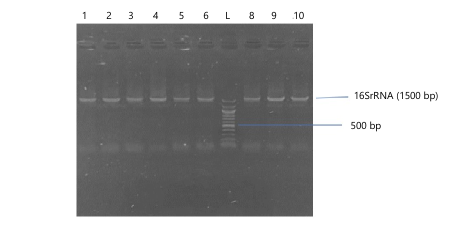
Biochemical and molecular identification of the selected bacterial isolates: The bacterial isolates were initially characterized using morphological and biochemical tests (Table 7) and subsequently identified by 16S rRNA gene sequencing (Fig. 1, Table 8). The agarose gel electrophoresis (Fig. 1) showed successful amplification of the 16S rRNA gene from the bacterial isolates. Lanes 1-10 showed distinct bands at approximately 1500 base pairs (bp), corresponding to the expected fragment size, while lane L contained a 100 bp DNA ladder that served as the molecular size marker. The obtained 16S rRNA gene sequences were subjected to a MegaBLAST search against the NCBI non-redundant nucleotide (nr/nt) database,
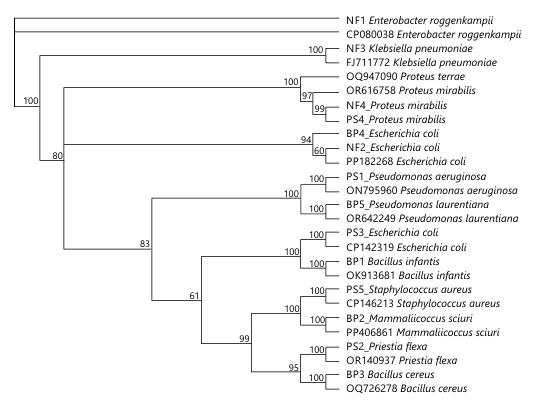
revealing 95-100% sequence similarity with reference sequences deposited in GenBank (Table 8), thereby confirming the taxonomic identities of the isolates. The nucleotide sequences generated in this study have been deposited in the GenBank database and assigned the accession numbers listed in Table 8. Phylogenetic analysis based on evolutionary distances estimated using the Jukes-Cantor model is presented in Fig. 2.
| Table 6: | Preliminary biodegradation potential of the consortium | |||
| Absorbance at 600 nm | |||
| S/N | Treatments | Day 0 | Day 16 |
| 1 | BP5/NF1 | 0.247±0.02 | 1.714±0.25 |
| 2 | BP5/PS2 | 0.304±0.15 | 1.834±0.02 |
| 3 | NF1/PS2 | 0.290±0.04 | 1.558±0.13 |
| 4 | BP5/NF1/PS2 | 0.282±0.07 | 2.751±0.04 |
| 5 | Control | 0.077±0.02 | 0.186±0.01 |
| OD<0.99: Moderate growth and OD>1.00: Heavy growth, BPB: Biosurfactant producing bacteria, NFB: Nitrogen fixing bacteria and PSB: Phosphate solubilizing bacteria | |||
| Table 7: | Cultural characteristics and biochemical reactions of the isolated bacteria | |||
| Isolates | Morphology | Gram’s reaction |
Catalase | Oxidase | Indole | Citrate | Methyl mortality |
Voges red |
H2S proskauer |
Production | Glucose | Sucrose | Lactose | Maltose | Mannitol | Probable organism |
| BP5 | R | - | + | + | - | - | + | - | - | - | - | - | - | - | - | Pseudomonas sp. |
| NF1 | R | - | + | - | - | + | + | - | + | - | + | + | - | + | + | Enterobacter sp. |
| PS2 | R | + | + | - | - | + | + | - | + | - | + | + | + | + | + | Priestiaflexa |
| R: Rods, C: Cocci, +: Positive and -: Negative | ||||||||||||||||
| Table 8: | Molecular identification of the selected bacterial isolates | |||
| Isolates code | Organism name | GenBank accession number | GenBank closest cultured organism |
| BP5 | Pseudomonas putida | PV290867.1 | Pseudomonas putida PC-578038 |
| NF1 | Enterobacter cloacae | PV290872.1 | Enterobacter cloacae TMX6 |
| PS2 | Priestiaflexa | PV290876.1 | Priestiaflexa B4BP |
| BP: Biosurfactant producer, NF: Nitrogen fixer and PS: Phosphate solubilizer | |||
DISCUSSION
Crude oil pollution remains a major environmental concern due to its adverse effects on soil quality and ecosystem function. In this study, the application of an bacterial consortium demonstrated strong potential for bioremediation of contaminated soil.
Baseline physicochemical analysis showed that polluted and pristine soils differed significantly, based on the baseline assessments. Compared to the pristine soil pH (pH 6.80), the polluted soil had a higher acidity (pH 5.60). This result is consistent with research by Onwuka et al.28, who reported that Niger Delta soils contaminated with crude oil had a mean pH of 5.32. Lindén and Pålsson29 also documented an average pH of 6.1 across 40 oil-polluted sites in Ogoniland. However, these pH values fell below the Federal Environmental Protection Agency (FEPA)30 permissible range of 6.5-8.5 for agricultural soils. This acidity may result from hydrocarbon accumulation and microbial production of organic acids.
The organic carbon content in the polluted soil was significantly higher than that of the pristine soil. This observation is in consonance with findings reported by Emmanuel et al.31, who recorded higher organic carbon levels in hydrocarbon-contaminated soils. The elevated organic carbon in the polluted soil samples is likely due to high hydrocarbon load present in the polluted soil. However, this contrasts with previous findings reporting a lower organic carbon content of 3.69% in crude oil-polluted soils. Such discrepancies may be attributed to differences in crude oil concentrations and the baseline organic matter content of soils in the different study locations.
The moisture content of the contaminated soil was significantly lower than that of the pristine soil. This observation is consistent with the findings of Devatha et al.32, who reported that petroleum hydrocarbon pollution often reduces water-holding capacity, moisture content, and hydraulic conductivity in soils. The lower moisture content in the crude oil-contaminated soil can be attributed to poor aeration resulting from water displacement, pore clogging, and the hydrophobic nature of hydrocarbons, which tend to coat soil particles, disrupt soil structure, and impair water retention.
Nutrient concentrations, particularly nitrogen and phosphorus, were notably lower in the contaminated soil than in the pristine soil. This finding aligns with the report by Udinyiwe et al.33. The reduction in nutrient levels is likely due to decreased nitrification and phosphate solubilization, resulting from impaired soil porosity and reduced aeration, both of which negatively affect the activity of nitrifying and solubilizing bacteria. Additionally, the acidic pH observed in the contaminated soil may further contribute to nutrient depletion, as soil pH strongly influences the solubility and availability of essential nutrients.
The total petroleum hydrocarbon (TPH) concentration in the polluted soil was 9,156.6 mg/kg, significantly higher than the 105 mg/kg recorded in the pristine soil, indicating severe hydrocarbon contamination. This value falls within the range of 126 to 52,200 mg/kg reported by the United Nations Environment Program (UNEP) along Shell Petroleum Development Company (SPDC) pipeline rights-of-way in Ogoniland, Rivers State, Nigeria. However, it far exceeds the Environmental Guidelines and Standards for the Petroleum Industry in Nigeria (EGASPIN) target value of 50 mg/kg for farmland.
Baseline microbiological analyses revealed lower total heterotrophic bacterial (THB) counts in the polluted soil than in the pristine soil, whereas hydrocarbon-utilizing bacterial (HUB) counts were higher in the polluted soil. The elevated THB count in pristine soil likely reflects favorable conditions, such as higher organic matter, moisture content, and nutrient availability, which are typically found in fallow, uncultivated soils that support microbial proliferation. In contrast, the reduced THB count in the polluted soil suggests the toxic effects of crude oil, which selectively eliminated non-resistant bacterial populations, leaving primarily hydrocarbon-degrading strains. This observation aligns with findings by Shi et al.34, who reported reduced microbial diversity following oil contamination. Additionally, crude oil pollution is known to stress soil environments by altering pH levels, reducing oxygen availability by creating anoxic zones, and consequently constraining microbial diversity and resilience.
Molecular characterization identified the most efficient isolates as Pseudomonas putida, Enterobacter cloacae, and Priestiaflexa. The recovery of P. putida is particularly noteworthy because members of the genus Pseudomonas are among the most extensively studied hydrocarbon-degrading bacteria and are recognized for their ability to metabolize a broad range of aliphatic and aromatic hydrocarbons while producing biosurfactants35.
An important aspect of crude oil bioremediation is the production of surface-active agents by microorganisms. In this study, four bacterial isolates were identified as biosurfactant producers; however, after careful screening using oil spreading, drop collapse, and emulsification activity test, Pseudomonas putida was identified as the best biosurfactant producer. Biosurfactant production was confirmed with oil spreading, drop collapse, and emulsification activity tests, which have been employed in previous studies26. The use of multiple screening methods for identifying biosurfactant-producing bacteria, as emphasized by Trindade et al.26, increases detection reliability compared with a single method. Specifically, the oil spreading technique has been highlighted as a sensitive and effective assay for detecting biosurfactant activity. The identification of Pseudomonas putida as a biosurfactant producer aligns with earlier findings36. Biosurfactant-producing bacteria play a crucial role in enhancing hydrocarbon bioavailability, a critical step in effective pollutant degradation. The availability of pollutants to microorganisms is critical for pollutant removal, as only bioavailable forms can be degraded.
Nitrogen and phosphorus are essential nutrients for microbial metabolism, and their deficiency can significantly hinder bioremediation efficiency. In this study, Enterobacter cloacaewas identified as the best nitrogen fixer, while Priestiaflexa was identified as the best phosphate solubilizer. These findings align with earlier reports in which Enterobacter cloacae and Klebsiella variicola were recognized as effective nitrogen fixers37. Similarly, the identification of Priestia sp. as a phosphate solubilizer corroborates the work of Ortega-Urquieta et al.38.
Assessment of hydrocarbon utilization revealed that all selected isolates were capable of growing with crude oil as the sole carbon source, although substantial variations in degradative performance were observed. Biosurfactant-producing isolates generally exhibited greater growth responses than several nitrogen-fixing and phosphate-solubilizing isolates, suggesting that enhanced hydrocarbon accessibility may have contributed to improved substrate utilization. Among the consortia screened for hydrocarbon degradation, the consortium comprising Pseudomonas putida, Enterobacter cloacae, and Priestiaflexa (BP5/NF1/PS2) showed the highest degradation efficiency. The synergistic effect of a consortium in the efficient degradation of hydrocarbons has been reported by several researchers39.
CONCLUSION
This study demonstrated that crude oil-polluted ferruginous soil harbors diverse indigenous bacteria with functional traits relevant to hydrocarbon biodegradation. Molecular characterization identified the most efficient isolates as Pseudomonas putida, Enterobacter cloacae, and Priestiaflexa. The greater hydrocarbon utilization exhibited by these isolates, both individually and as a consortium, highlights their potential for application in the bioremediation of petroleum-contaminated environments. These findings highlight the ecological significance of indigenous microbial communities as sustainable resources for environmental restoration and support the continued biomining of impacted ecosystems for the discovery of beneficial microorganisms with biotechnological applications in pollution control and waste management.
SIGNIFICANCE STATEMENT
This study highlights the potential of indigenous microorganisms from crude oil-polluted ferruginous soil as promising candidates for sustainable bioremediation. The identification of efficient hydrocarbon-degrading, biosurfactant-producing, nitrogen-fixing, and phosphate-solubilizing bacteria demonstrates their possible application in restoring petroleum-impacted soils while supporting soil fertility. The molecular identification of Pseudomonas putida, Enterobacter cloacae, and Priestiaflexa further provides valuable microbial resources for developing locally adapted and environmentally friendly strategies for the remediation of oil-contaminated ecosystems in Nigeria.
ACKNOWLEDGMENT
The authors sincerely appreciate the management and staff of the Department of Microbiology, University of Benin, and Prof. Tatfeng Molecular Laboratory, Yenagoa, Bayelsa State, Nigeria, for providing the laboratory facilities and technical support required for the successful execution of this study. The authors also acknowledge the management and staff of Federal University Wukari, Taraba State, Nigeria, and Edwin Clark University, Kiagbodo, Delta State, Nigeria, for providing a conducive environment for data analysis, manuscript preparation, and quality evaluation of the manuscript.
REFERENCES
- Dey, S., A. Das, K. Mallick, A. Sahu and A.P. Das, 2024. Environmental Petroleum Waste: Pollution, Toxicity, Sustainable Remediation. In: Impact of Petroleum Waste on Environmental Pollution and its Sustainable Management Through Circular Economy, Behera, I.D. and A.P. Das, Springer Nature, Switzerland, ISBN: 978-3-031-48220-5, pp: 159-175.
- Ghisman, V., A.C. Muresan, N.L. Bogatu, E.E. Herbei and D.L. Buruiana, 2025. Recent advances in the remediation of degraded and contaminated soils: A review of sustainable and applied strategies. Agronomy, 15.
- Mohanta, S., B. Pradhan and I.D. Behera, 2024. Impact and remediation of petroleum hydrocarbon pollutants on agricultural land: A review. Geomicrobiol. J., 41: 345-359.
- Ali, I.M., 2024. Remediation techniques for soil contaminated with petroleum products: A review. Iraqi J. Oil Gas Res., 4: 25-38.
- Kour, D., T. Kaur, R. Devi, A. Yadav and M. Singh et al., 2021. Beneficial microbiomes for bioremediation of diverse contaminated environments for environmental sustainability: Present status and future challenges. Environ. Sci. Pollut. Res., 28: 24917-24939.
- Aso, R.E. and I.S. Obuekwe, 2024. Polycyclic aromatic hydrocarbon: Underpinning the contribution of specialist microbial species to contaminant mitigation in the soil. Environ. Monit. Assess., 196.
- Mekonnen, B.A., T.A. Aragaw and M.B. Genet, 2024. Bioremediation of petroleum hydrocarbon contaminated soil: A review on principles, degradation mechanisms, and advancements. Front. Environ. Sci., 12.
- Hosseini, H., H.M. Al-Jabri, N.R. Moheimani, S.A. Siddiqui and I. Saadaoui, 2022. Marine microbial bioprospecting: Exploitation of marine biodiversity towards biotechnological applications-a review. J. Basic Microbiol., 62: 1030-1043.
- Chauhan, A.S., C.W. Chen and C.D. Dong, 2026. Synergistic bioremediation of polycyclic aromatic hydrocarbons and heavy metals: A comprehensive review. Rev. Environ. Sci. Biotechnol., 25.
- Castro, A.R., G. Martins, A.F. Salvador and A.J. Cavaleiro, 2022. Iron compounds in anaerobic degradation of petroleum hydrocarbons: A review. Microorganisms, 10.
- Yu, X., X. Zhang, P. Yang, J. Sun and Y. Yang et al., 2025. Ferrihydrite redox enhanced biodegradation of petroleum hydrocarbons coupling with conversion of soil multi-elements by electron transfer. J. Hazard. Mater., 496.
- Asma’u Muhammad, A., I.A. Dabban, A.H. Muhammad, A.M. Babadoko and A.O. Felicia, 2025. Evaluation of rhizosphere bacteria associated with Spinacia oleracea for plant growth-promoting potentials in Bida, Niger State, Nigeria. UMYU J. Microbiol. Res., 10: 572-581.
- Effiong, E., O.K. Agwa and G.O. Abu, 2019. Niche-proxies of hydrocarbon-impacted rhizosphere soil of weeds of Bodo in Gokana, Rivers State, Nigeria. Arch. Curr. Res. Int., 19.
- Agbaji, J.E., E. Effiong and G.C. Iheanacho, 2024. Parameter Affinity Estimation of Rhizobacterial Cocktail Formulations for Hydrocarbon Degradation Using Locally Available Substrates in Crude Oil-Impacted Soil. In: Updates on Rhizobacteria, Gull, M. (Ed.), IntechOpen, London, United Kingdom, ISBN: 978-1-83769-480-8 .
- Takamoto, A., T. Takahashi and K. Togami., 2023. Estimation models from soil pH with a solid-to-liquid ratio of 1:2.5 to pH measured by other methods using soils in Japan. Soil Sci. Plant Nutr., 69: 190-198.
- Rubio, C.A.N., M.T. Perea, H.M. Ángeles, J.G.R. Moreno, R.V. Carrillo-Serrano and S. Obregón-Biosca, 2025. Predictive model of electrical resistivity in sandy, silty and clayey soils using gravimetric moisture content. Eng, 6.
- Walkley, A. and I.A. Black, 1934. An examination of the degtjareff method for determining soil organic matter, and a proposed modification of the chromic acid titration method. Soil Sci., 37: 29-38.
- Johnson, N. and I. Chigozie, 2025. Effectiveness of liquid soap and NPK fertilizer in enhancing bioremediation of petroleum hydrocarbon-contaminated soil. BIOS: J. Inf. Sains, 3.
- Murphy, J. and J.P. Riley, 1962. A modified single solution method for the determination of phosphate in natural waters. Anal. Chim. Acta, 27: 31-36.
- Iheanacho, C.C., A.T. Lee-Ann, M.A. Abah, N.S. Onyekachi and R.E. Aso, 2026. Isolation and characterization of fungal isolates from hydrocarbon contaminated intertidal sediment of Amadi-Ama Creek, Bonny River. Res. J. Microbiol., 21: 1-10.
- Ogodo, A.C., D.I. Agwaranze, M. Daji and R.E. Aso, 2022. Microbial Techniques and Methods: Basic Techniques and Microscopy. In: Analytical Techniques in Biosciences: From Basics to Applications, Egbuna, C., K.C. Patrick-Iwuanyanwu, M.A. Shah, J.C. Ifemeje and A. Rasul (Eds.), Elsevier, Amsterdam, Netherlands, ISBN: 978-0-12-822654-4, pp: 201-220.
- Adekunle, A.S., J.A.O. Oyekunle, O.S. Ojo, O.W. Makinde, T.T.I. Nkambule and B.B. Mamba, 2020. Heavy metal speciation, microbial study and physicochemical properties of some groundwaters: A case study. Chem. Afr., 3: 211-226.
- Mezoughi, A.B., A.S. Amer, Z.O. Ettarhouni, K.M. Ibrahim, Z.K. Kremed and A. Bhattarai, 2026. Screening and characterisation of petroleum hydrocarbon-degrading bacteria isolated from petroleum-contaminated soil in Libya. Biodegradation, 37.
- Tran, L.T. and C. van Nguyen, 2026. Nitrogen-fixing and phosphate-solubilizing Bacillus stercoris CMB2 from baby maize roots. Nitrogen, 7.
- Ohijeagbon, O.R., A.A. Ayandele, J.A. Amao and O.G. Omotoso, 2026. Isolation and characterization of bacteria with potential as hydrocarbon component degraders from bitumen-contaminated soil. J. Adv. Microbiol., 26: 45-56.
- Trindade, M., N. Sithole, S. Kubicki, S. Thies and A. Burger, 2021. Screening Strategies for Biosurfactant Discovery. In: Biosurfactants for the Biobased Economy, Hausmann, R. and M. Henkel (Eds.), Springer International Publishing, Switzerland, ISBN: 978-3-031-07337-3, pp: 17-52.
- Jukes, T.H. and C.R. Cantor, 1969. Evolution of Protein Molecules. In: Mammalian Protein Metabolism, Munro, H.N. (Ed.), Academic Press, Cambridge, Massachusetts, ISBN: 9781483232119, pp: 21-132.
- Onwuka, C., A.N. Eboatu, V.I.E. Ajiwe and E.J. Morah, 2021. Pollution studies on soils from crude oil producing areas of Rivers State, Niger Delta Region, Nigeria. Open Access Lib. J., 8.
- Lindén, O. and J. Pålsson, 2013. Oil contamination in ogoniland, Niger Delta. AMBIO, 42: 685-701.
- FEPA, 1991. Guidelines and Standards for Environmental Pollution Control in Nigeria. Federal Environmental Protection Agency, Nigeria, Pages: 238.
- Emmanuel, O., E. Enobong and Abu Gideon, 2018. Laboratory-scale bioremediation of crude oil polluted soil using a consortia of rhizobacteria obtained from plants in Gokana-Ogoni, Rivers State. J. Adv. Microbiol., 9.
- Devatha, C.P., A.V. Vishal and J.P.C. Rao, 2019. Investigation of physical and chemical characteristics on soil due to crude oil contamination and its remediation. Appl. Water Sci., 9.
- Udinyiwe, C.O., I.B. Idemudia and F.O. Ekhaise, 2022. Biodegradation potential of bacterial isolates from crude oil contaminated soil samples from Gelegele River, Edo State. NIPES-J. Sci. Technol. Res., 4: 244-257.
- Shi, L., Z. Liu, L. Yang and W. Fan, 2022. Effects of oil pollution on soil microbial diversity in the Loess hilly areas, China. Ann. Microbiol., 72.
- Medić, A.B. and I.M. Karadžić, 2022. Pseudomonas in environmental bioremediation of hydrocarbons and phenolic compounds- key catabolic degradation enzymes and new analytical platforms for comprehensive investigation. World J. Microbiol. Biotechnol., 38.
- Saruni, N.H., S. Abdul Razak, S. Habib, S.A. Ahmad and S.A. Alias et al., 2022. Comparative screening methods for the detection of biosurfactant-producing capability of antarctic hydrocarbon-degrading Pseudomonas sp. J. Environ. Microbiol. Toxicol., 7: 44-47.
- Ji, C., Z. Liu, L. Hao, X. Song and C. Wang et al., 2020. Effects of Enterobacter cloacae HG-1 on the nitrogen-fixing community structure of wheat rhizosphere soil and on salt tolerance. Front. Plant Sci., 11.
- Ortega-Urquieta, M.E., V. Valenzuela-Ruíz, D. Mitra, S. Hyder and N.I. Elsheery et al., 2022. Draft genome sequence of Priestia sp. strain TSO9, a plant growth-promoting bacterium associated with wheat (Triticum turgidum subsp. durum) in the Yaqui Valley, Mexico. Plants, 11.
- Wang, D., L. Qin, E. Liu, G. Chai and Z. Su et al., 2022. Biodegradation performance and diversity of enriched bacterial consortia capable of degrading high-molecular-weight polycyclic aromatic hydrocarbons. Environ. Technol., 43: 4200-4211.
How to Cite this paper?
APA-7 Style
Aso,
R.E., Effiong,
E., Obuekwe,
I.S., Ogugbue,
C.J. (2026). Bioremediation Potential of Microbiota Isolated from Oil-Polluted Ferruginous Soil. Research Journal of Microbiology, 21(1), 37-49. https://doi.org/10.3923/rjm.2026.37.49
ACS Style
Aso,
R.E.; Effiong,
E.; Obuekwe,
I.S.; Ogugbue,
C.J. Bioremediation Potential of Microbiota Isolated from Oil-Polluted Ferruginous Soil. Res. J. Microbiol 2026, 21, 37-49. https://doi.org/10.3923/rjm.2026.37.49
AMA Style
Aso
RE, Effiong
E, Obuekwe
IS, Ogugbue
CJ. Bioremediation Potential of Microbiota Isolated from Oil-Polluted Ferruginous Soil. Research Journal of Microbiology. 2026; 21(1): 37-49. https://doi.org/10.3923/rjm.2026.37.49
Chicago/Turabian Style
Aso, Rufus, Emamoge, Enobong Effiong, Ifeyinwa Sarah Obuekwe, and Chimezie Jason Ogugbue.
2026. "Bioremediation Potential of Microbiota Isolated from Oil-Polluted Ferruginous Soil" Research Journal of Microbiology 21, no. 1: 37-49. https://doi.org/10.3923/rjm.2026.37.49

This work is licensed under a Creative Commons Attribution 4.0 International License.
